| Title | How to Correctly Determine Gas Spring Size: Complete Guide for Replacement and Customization |
|---|---|
| Image View | 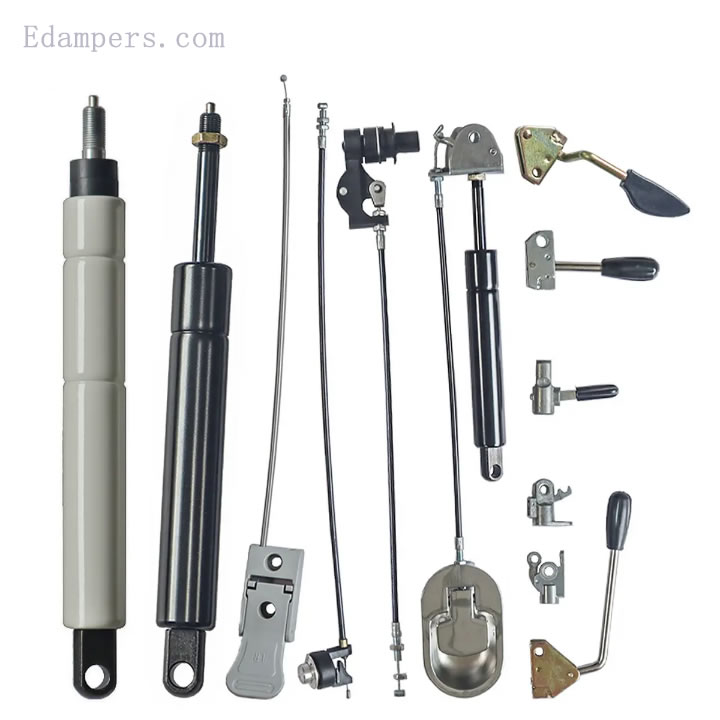 |
| Blog Details |
How to Correctly Determine Gas Spring Size: Complete Guide for Replacement and Customization As a gas spring exporter, we know how crucial it is to get the right size during repair and replacement. This guide will help you and your repair company customers accurately measure and customize gas springs for a perfect fit. Why Is Accurate Sizing So Important? A correctly sized gas spring ensures: - Safe and reliable equipment operation - Optimal opening/closing force - Longer equipment lifespan - Avoids repeat purchases and return costs Gas Spring Replacement: 4-Step Method to Determine Size Step 1: Gather Basic Parameters (The 4 Most Critical Measurements) 1. Fully Extended Length - Measure from the center of one mounting point to the center of the other - The gas spring must be fully extended 2. Stroke Length - Measure the distance the piston rod travels from fully compressed to fully extended - Alternatively, measure the center-to-center distance when compressed 3. Mounting End Types - Identify the style of both ends: - Threaded (specify metric or imperial, thread diameter & length) - Eyelet (measure inner diameter and width) - Ball socket (measure ball diameter) - Bracket or custom fitting 4. Installation Direction - Note the piston rod orientation (up, down, or horizontal) - This affects lubrication and seal design Step 2: Determine Force Requirements 1. Test Force of Existing Spring (if it still works somewhat) - Use a force gauge - Record force at both fully extended and compressed positions 2. Calculate Required Force (if old spring is completely failed) - Measure the weight of the door/lid - Consider leverage ratio (distance from mount to hinge) - Consider environment (temperature, frequency of use) Step 3: Check Special Requirements 1. Operating Temperature Range - Standard: -20°C to +80°C - High/low temperatures need special seals and gas 2. Surface Finish - Standard: Black epoxy coating - Special environments may need: zinc plating, stainless steel, or stainless piston rods 3. Speed Control - Is damping needed? - End-of-stroke cushioning required? Step 4: Document and Verify Create a checklist to ensure all parameters are recorded: - [ ] Fully Extended Length - [ ] Stroke Length - [ ] Compressed Length - [ ] Mounting End Types (both ends) - [ ] Piston Rod Diameter - [ ] Cylinder Tube Diameter - [ ] Force Requirement - [ ] Operating Temperature Range - [ ] Surface Finish Requirement - [ ] Special Function Requirements Customizing New Gas Springs: Considerations Beyond Replacement When standard replacement isn't possible, custom solutions need extra thought: Application-Specific Factors: 1. Load Dynamics: Is it static support or frequent dynamic movement? 2. Space Limitations: Are there size restrictions? 3. Safety Needs: Are explosion-proof, locking, or slow-close features needed? 4. Lifecycle Expectation: How many cycles are expected? Professional Measuring Tips: 1. Use the Right Tools: Tape measure, calipers, force gauge 2. Take Multiple Measurements: Especially for old, worn equipment 3. Take Reference Photos: Include the installation environment, any labels on the old spring 4. Record Equipment Model & Maker: Helps with cross-referencing Common Mistakes & How to Avoid Them 1. Measuring Mounting Centers Wrong - Correct way: Always measure from hole center to hole center 2. Ignoring Installation Angle - The angle can greatly change the actual force needed 3. Assuming "Looks the Same" Means "Performs the Same" - Similar-looking springs can have very different forces and strokes 4. Overlooking the Environment - Extreme temperatures or corrosive settings need special materials Our Support Services As your gas spring supplier, we offer: - Free Size Verification: Send your measurements, we'll review them - Replacement Matching: We can find matches even without original part numbers - Custom Design Support: Engineer help for non-standard applications - Sample Testing Program: Chance to verify before bulk ordering Next Steps 1. Use our Gas Spring Measurement Form (ask us for the digital version) 2. Take clear photos: overall equipment, mounting points, old spring labels 3. Send the info to us for size verification 4. Order test samples or production based on our recommendation Pro Tip: Even if you're confident in your measurements, test a sample before bulk ordering. This saves time, avoids cost, and ensures customer satisfaction. --- |
| More Details |
Here is the gas spring custom made system for reference : https://www.edampers.com/customized_gas_spring.html , |
| Update Time | 2026-01-15 02:54:52 |
| ID | 107 |
| Create User | 500052 |